workslopping
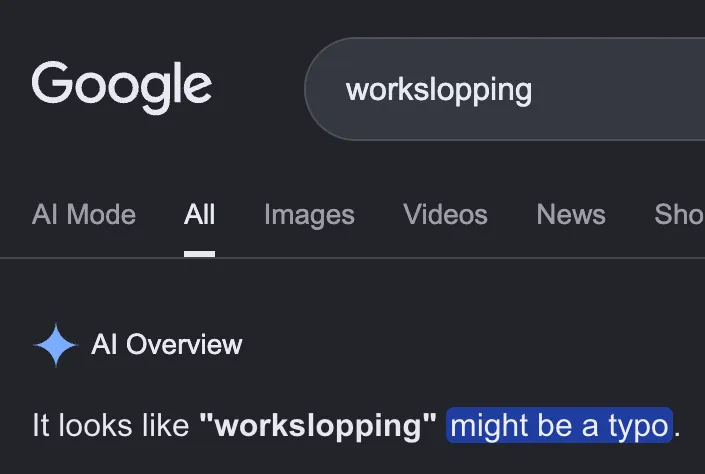
How ironic…
Also, this one is vertical (and significantly shorter).
New: Translated in Thai, and Japanese
Please scroll down to read it.
Welcome back to my quarterly newsletter.
I’ve received feedback that horizontal scrolling for 100+ pages is a bit of an ergonomic mess. So hopefully it’s a bit easier to read.
You might be able to see the Share 📤 button at the top too.
Hope you like it enough to do so.
I use AI a lot at work
One advantage of AI is that it makes tedious but valuable tasks more cost-effective. I would not put manual labor into these tasks otherwise.
- Cross-referencing between different sources of information
- Running ablation tests to trim down bloats from my code
- Pattern-matching what I did for one task onto another
- Writing a newsletter (jk lol)
Please do use them!
I never hate1 AI and I’m happy to see people compensating for gaps in their background in one area and magnifying their capabilities in another.
If you don’t know how to code, don’t let people gatekeep you from building cool stuff.
- 1
Hate is a strong word! I just sometimes get frustrated when I know the exact reason why it fails and it fails right in front of me that way. Murphy’s law, I guess. ↩
Some people might disagree and feel threatened.
AI is bad.
But… why? What went wrong?
Capabilities of AI nowadays are significantly better than even 3 months ago, and things change fast.
How come we still associate LLMs with low-quality slop?
I don’t know

And yes! That’s exactly the theme of this argument.
Being able to say I don’t know is a good start.
People are reluctant to admit they don’t know something, even when accuracy is at stake.2
- 1
AI advice suppresses people’s willingness to say “I don’t know”, even when the advice is wrong and accuracy is incentivized (https://arxiv.org/abs/2607.13562) ↩
This can be especially hard in high-context environments, where people may hint that you should figure out the answer yourself instead of asking directly.
Just Google it. Why are you asking me?
It makes you adopt an answer before you’ve made sense of it yourself.
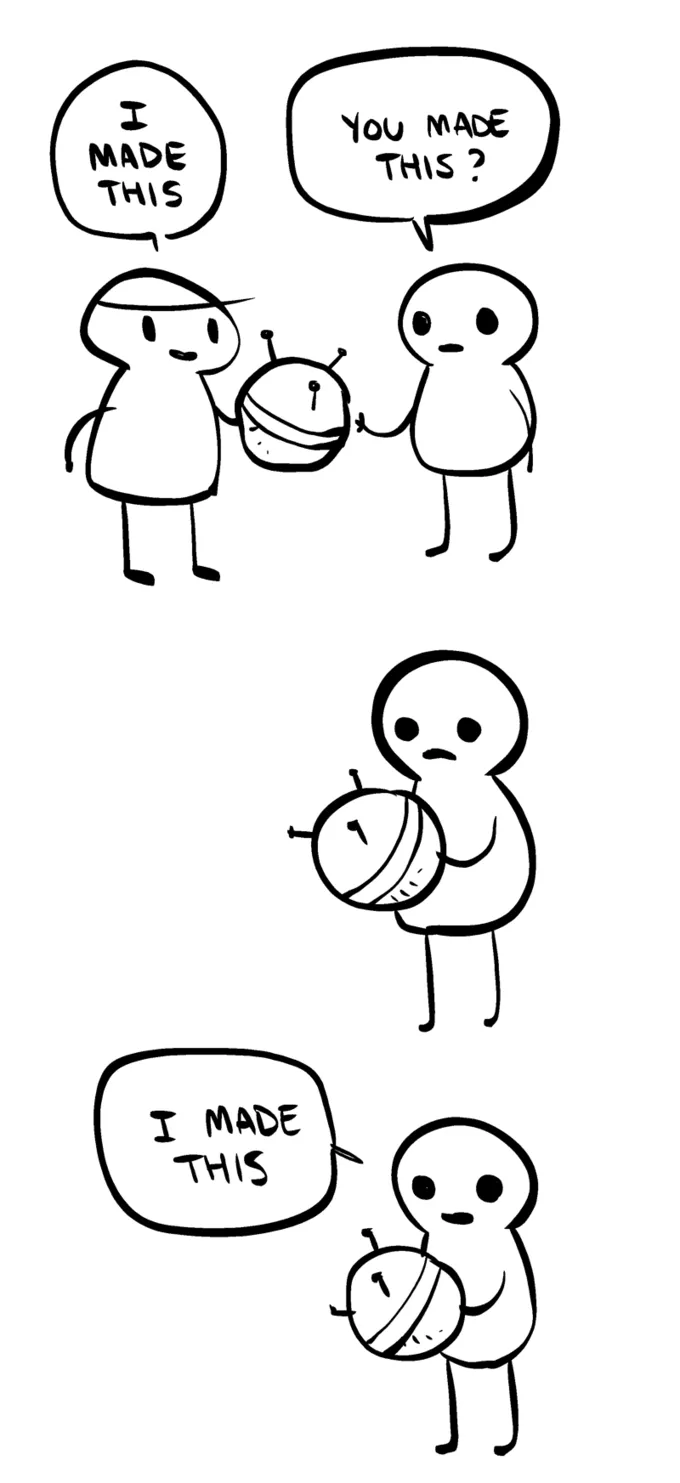
But you claim it as yours with your own credibility on the line.
- 1
That’s why the academic world values citations and proper attribution and why saying using AI does not count as infringement misses the point.
Copyright is a legal issue, but plagiarism is an ethical one.
-
Copy-and-paste an entire Wikipedia article?
-
Google Translate your homework from your native language in an English class?
-
Word-for-word excerpt from another source without citation?
These have been around for decades
Sure, we all agree we can’t rely on Wikipedia because it can make mistakes.
But conversely, we also can’t rely on it making mistakes just to avoid citing Wikipedia.
Our teachers used to be able to say that only because:
It was actually unreliable at the time
Now it’s not, thanks to the community constantly updating and correcting it.
That argument starts to lose its weight.
The same goes for AI.
If our only objection to AI is that its output looks like “slop,” that objection weakens as the output improves.
One might even say we should be grateful that AI still produces sloppy work distinguishable from real human effort.
- 1
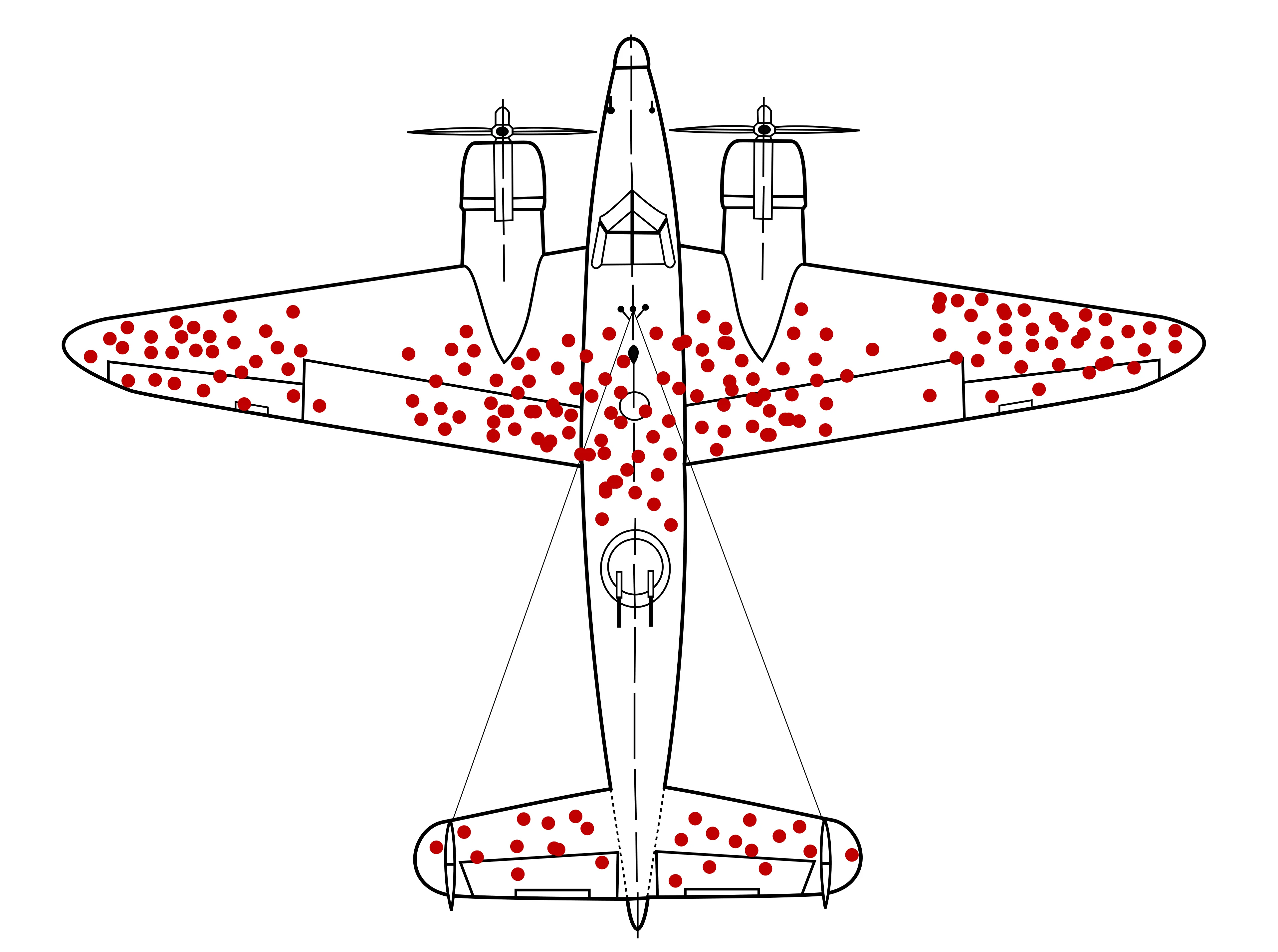
By Martin Grandjean (vector), McGeddon (picture), US Air Force (hit plot concept) - Own work, CC BY-SA 4.0 Link ↩
Once it doesn’t matter anymore who did the work, it starts to matter more who did the work.
Take your time to understand the work you’re willing to put your reputation on.
But does it really matter?
So-called “vibe-coders” can now produce a polished (?) prototype that works in a few hours.
AI “artists” can churn out impressive pieces quickly.
Yet why do we care if it remains a prototype or a hobby project that never affects you? It’s absurd to get upset about it?
Don’t you think we’re putting our anger at the wrong place?
It starts to matter when this work crosses
The Interpersonal Boundary
There are two failure modes here.
-
But this was supposed to be done by you…
This happens when the human judgement and the process of creating the work itself matter more than the final result.
Asking for someone’s input and then having them go with “Claude said” can feel frustrating.
Art communities often value the process more than the final piece. Putting effort into esoteric details shows your target audience you care, and that’s the message in and of itself.
Of course using a tool for shortcuts is not inherently bad.
There is even a level to this. For example, some purists might say “photography isn’t art.”
That does not matter if you share it to a photography club, so figure out who your audience is.
At the end of the day, remind yourself of The Death of the Author.
If your audience thinks 0.1% that AI helped destroy the point you were making, then either change your target audience or respect them.
Stating your opinion based on an AI response or does not help. Your audience could have just asked the AI themselves.
-
This was definitely unconfirmed so I must check
Some work, like research, technical claims, or software code, needs careful verification, and the end product matters most.
Your audience (e.g., in this case, reviewers, auditors, or QA) will not necessarily care if it was automated; in fact, they might often hope that it was, because you are more prone to human error.
This is why Math, Computer Science, and Software Engineering welcome AI with open arms because we are always eager to abstract and automate our work as long as it can be trusted.
But if you blur the line between human and AI work and shift the burden to the person who failed to catch the mistake, this now becomes a problem of trust and accountability.
Oopsie. Claude did it. Sorry, AI might make mistakes sometimes.
Does this remind you of anything?
Years ago, when self-driving cars were new, there was a debate about how much responsibility should lie with the driver versus the system.
It was clear from the start. It was never about the definition of “mistakes”, nor how perfect the system could be.
Why are we even discussing who to hit if the very existence of the debate itself already proves the lack of an attribution framework?
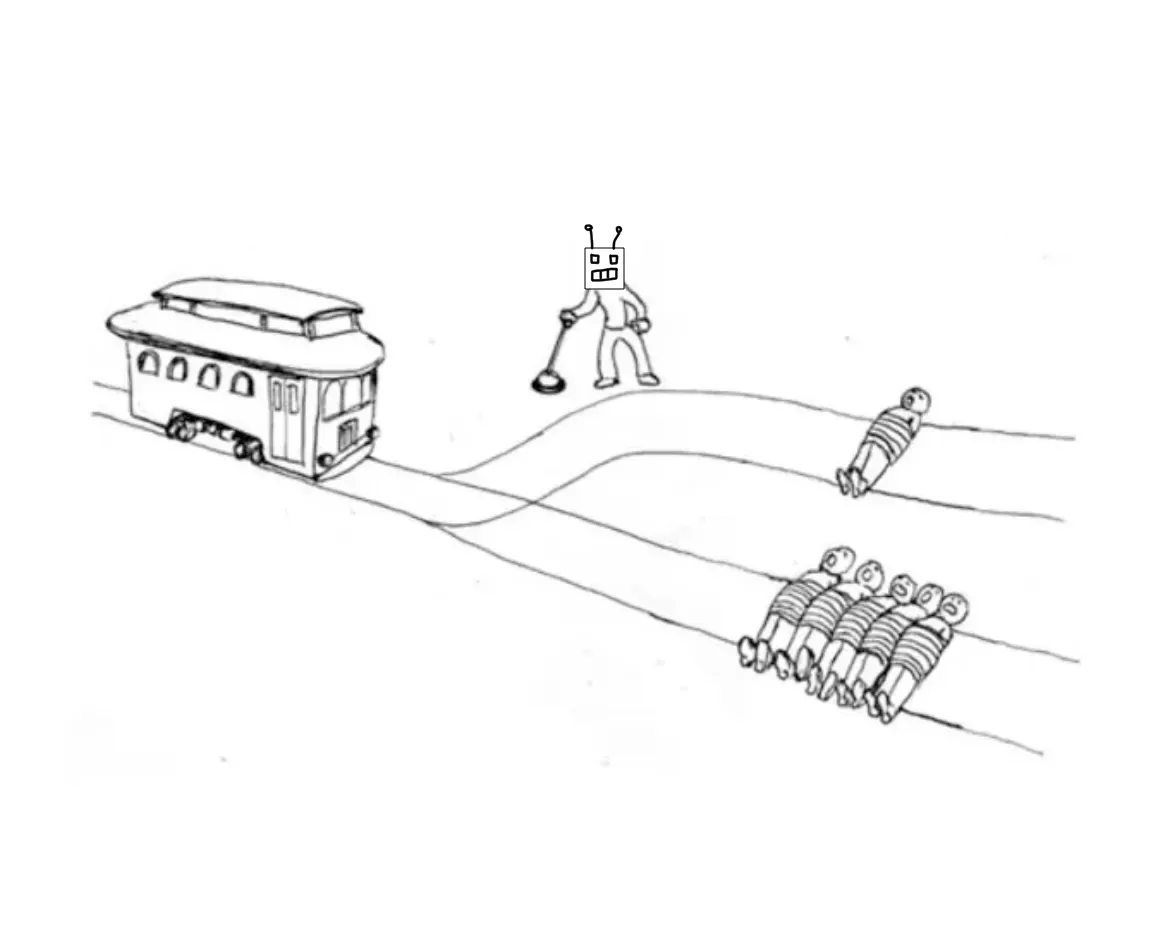
It was not a moral dilemma. It should be clear who sets the rules for an automated decision.6
- 1
Originally drawn by Prof. Jesse Prinz, edited by me. ↩
- 2
I didn’t say they were 100% liable, just that if they want the responsibility to be shared, they need to prove how much control the passenger/driver had, hence “it should be clear”. ↩
The system builder can’t just keep arguing in good faith and shift the responsibility to the regulators.
Hey, if it’s not good, I will just put more effort into making it better. Otherwise, just make a law to stop me.
Now you’re stopping me? Why are you against the development of the thing that will help humanity?
Good thing we still have some sensible policies in place.
Some emerging repositories are now explicitly disallowing outside contributions.
AI has made writing code easy. The hard part, today, is not writing the code, but reviewing it, making sure quality stays high, and keeping the product coherent.
— Cloudflare OS maintainers
Now that we have AI…
Isn’t it cheap to just ask Claude to prototype this? I wanna see if rewriting an entire codebase with AI and reverse-engineering a well-known product from scratch will improve our metric B and help us sell more to customers.
Right?
If you want an answer to that, Things you should never do, Part 1 (2000) is even OLDER than me. And yet, it is still relevant today.
The Decoherence Trap spells out the same idea much more clearly than I’m about to. I highly recommend reading it.
We ship sooner, celebrate small wins, and shift the burden to the next person maintaining the system. And this leads to the third component of the workslopping problem.
We reward people for being locally coherent but ignores the systemic incoherence that emerges from the number of interactions between its parts.
workslopping
[n.] The act of cognitively offloading work to another human being regardless of efficiency, effort, or intent, often seen in complex, high-pressure environments, and commonly (but mistakenly) rewarded by the local optimization yet resulting in net-negative outcomes.
But Do ‘I’ Make workslop?
Until here, we have been mostly discussing it from an observer’s perspective, in a hypothetical timeframe.
There was no strict use of a first-person pronoun (I have been using third-person ‘I’ artistically) nor a clear sense of the present.
Now let’s talk about ‘I’ as in me, from my own experience.
Yes, I know that it isn’t easy to stay fully aware when you’re a part of the system itself.
I acknowledge that it takes a lot of social and emotional courage to push back on changes, while also communicating how it does not mean you are entirely against the idea.
There are deadlines. There are contract obligations and debts chained from one coworker to another, from one company to another company down the line. They need your work to do their work that someone else needs.
You can’t really say “but wait” without paying an opportunity cost.
Breaking the fourth wall to say this makes my idea less practical. I risk losing credibility by being hypocritical.
Aw, but I use AI to write code too, so I don’t have a say in this. Let’s just each turn a blind eye on one another.
I admit that writing this article is really awkward. I started writing this article a month ago and have been shaping it slowly since then to make it coherent.
I like to think that it’s okay, and this awkwardness strengthens the argument itself.
It’s evidence that being aware does not make it easier to avoid.
Why don’t I become the decision maker myself?
I got asked a lot why I chose to be employed instead of freelancing or starting my own business, especially given my views on workslopping.
It’s much harder to notice circular, side-way involution when you’re working alone.
The first week of my job was a breeze. This project? I could have done the entire thing in a day. I had dreams of many features of our product already planned, and I built many small PoCs relatively quickly.
But the reality hit me soon after I added more layers on top of things. The only way to validate my ideas was to see them folding against themselves, exceeding my cognitive limits, even before it is used by anyone.
There were no security concerns, bugs, or performance issues yet. It was purely internal chaos. Zero customers; nobody was dissatisfied.
Again, I can’t stress enough that slop was never about low quality but rather the burden it leaves you to decipher.
Things have changed, and I learned to push back on requirements, admit that it doesn’t make any sense, yet also be willing to correct my mistakes.
Even the correction itself can be wrong, and it’s okay to convince them that we can push forward.
The perk of being employed is that my work can be viewed from a different angle and a wider perspective.
This means it is less punishing to be wrong. And boy do I love being wrong sometimes.
Moreover, I get a low-risk space to experiment; they get to keep innovating. That’s a win-win for me.
And it’s never too late to go back and keep dreaming about new ideas when I learn how to properly manage my cognitive load.
To be honest, I don’t know what the point of being self-employed or building a startup is for others, and I absolutely respect it.
For me, if I have a problem with a target audience I care about, I’d prefer not to exploit it for profit.
And if I have a problem I care about without a target audience, I would rather not pursue or invent a problem for them.
Because even when I work alone, I also choose not to pass this workslopping onto my customers.
Until here, you might notice that I did not treat workslopping as inherently negative but rather as a natural part of work that will soon result in negative outcomes.
Unfortunately, it will happen to you, and you might cause it to happen to others too.
Please be mindful and try to manage it well.